
My Cart
0 items
Genuine Automation Parts | Worldwide Express Delivery | 12-Month Warranty — [GET A QUOTE]

The 1769-L32C (Part Number: 1769-L32C) is a high-performance programmable automation controller within the Allen-Bradley CompactLogix family, specifically designed for applications requiring integrated ControlNet connectivity. This controller acts as a critical network manager, capable of...
Availability: Low stock: 99 left
Reliable Worldwide Delivery
30-Day Money-Back Guarantee
Need more details? Read our fullShipping PolicyandRefund Policy.


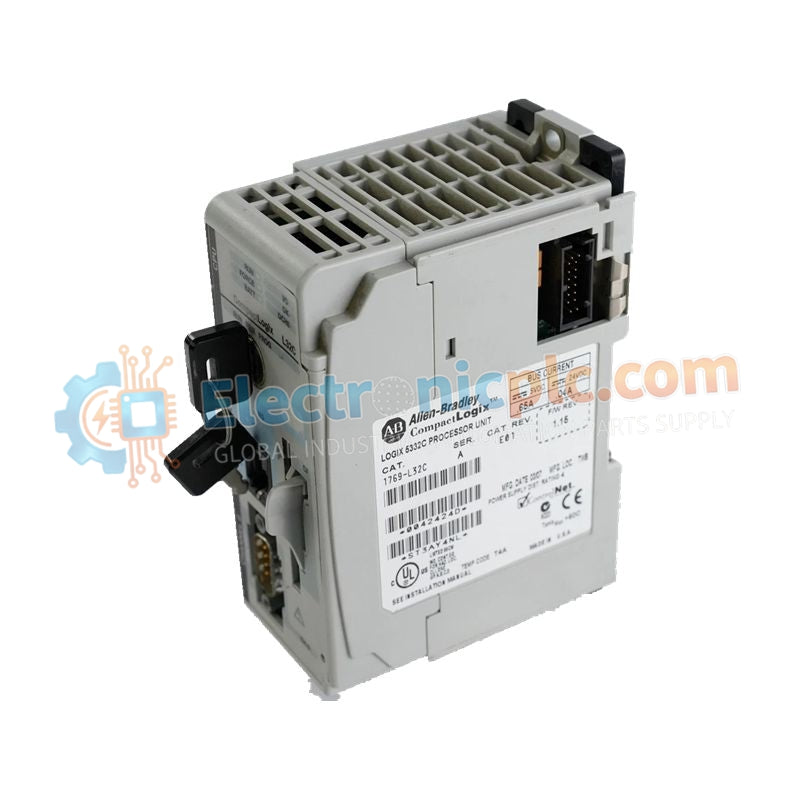
The 1769-L32C (Part Number: 1769-L32C) is a high-performance programmable automation controller within the Allen-Bradley CompactLogix family, specifically designed for applications requiring integrated ControlNet connectivity. This controller acts as a critical network manager, capable of storing scheduled network configurations and parameters essential for stable system initialization. With robust memory capacity and flexible I/O expansion, it serves as a reliable logic engine for mid-sized industrial architectures.
Equipped with a specialized ControlNet port on Channel A, the 1769-L32C facilitates deterministic, high-speed data transfer across the plant floor. It also supports local expansion of up to 16 I/O modules across a maximum of three I/O banks, ensuring scalability for growing production lines. For maintenance and backup, the unit utilizes the user-replaceable 1769-BA lithium battery to preserve project memory during power loss.
| Specification | Details |
|---|---|
| User Memory | 750 KB available for logic and data storage |
| Expansion Capacity | Supports up to 16 local 1769 I/O modules |
| I/O Banks | Maximum of 3 expansion banks |
| Backplane Current Draw | 650 mA at 5V DC and 40 mA at 24V DC |
| Operating Temperature | 0 to 60 °C (32 to 140 °F) |
| Mounting Options | DIN rail or Panel mount |
The 1769-L32C is ideal for decentralized control systems where deterministic communication is essential. Common deployments include:
High-speed packaging lines
Water treatment telemetry
Synchronized material handling systems
These systems require precise timing, which is facilitated via ControlNet connectivity.
What is the purpose of the NAP port on this controller?
The Network Access Port (NAP) allows for a temporary connection point for programming terminals or HMI devices to access the ControlNet network without interrupting the trunk line.
How many tasks can this controller run simultaneously?
The 1769-L32C supports up to 16 tasks, including one continuous task and the rest as periodic or event-based tasks.


