
My Cart
0 items
Genuine Automation Parts | Worldwide Express Delivery | 12-Month Warranty — [GET A QUOTE]

The 1769-OV32T (Part Number: 1769-OV32T) is a high-density, solid-state digital output module engineered for the Allen-Bradley CompactLogix and MicroLogix 1500 platforms. This module provides 32 sinking DC outputs, making it an ideal choice for space-conscious applications that require controlling...
Availability: Low stock: 99 left
Reliable Worldwide Delivery
30-Day Money-Back Guarantee
Need more details? Read our fullShipping PolicyandRefund Policy.


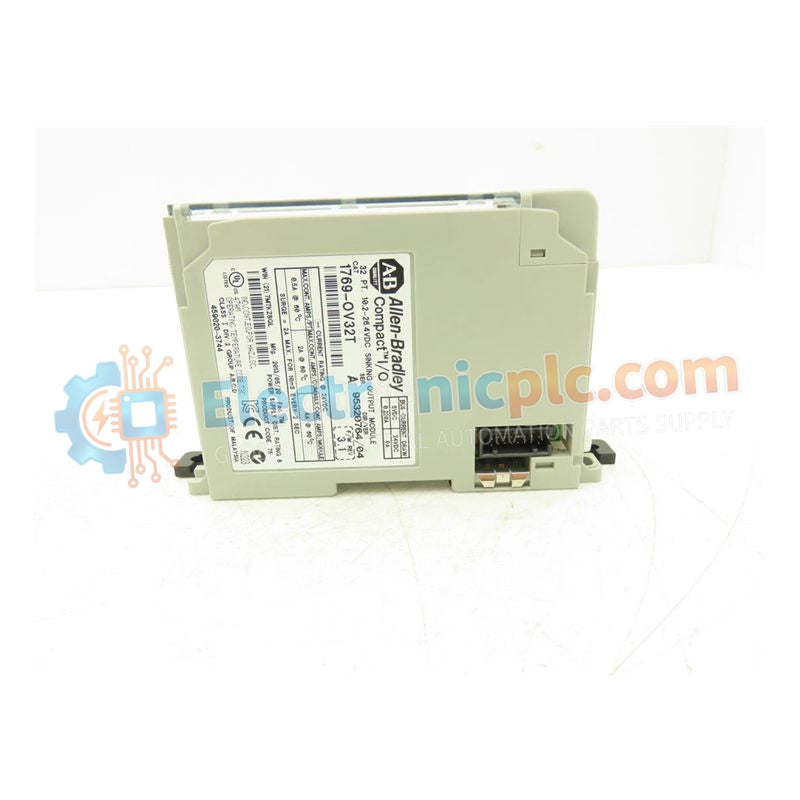
The 1769-OV32T (Part Number: 1769-OV32T) is a high-density, solid-state digital output module engineered for the Allen-Bradley CompactLogix and MicroLogix 1500 platforms. This module provides 32 sinking DC outputs, making it an ideal choice for space-conscious applications that require controlling a large number of low-power DC loads such as solenoids, interface relays, and pilot lights.
Designed for seamless integration, the 1769-OV32T utilizes a tongue-and-groove interlocking system that ensures a secure physical and electrical connection to adjacent 1769 modules or controllers. The "T" suffix in the model number denotes that this module includes a high-density terminal block interface, requiring specific wiring techniques to manage the 32 output points within a slim 35mm housing. To ensure long-term reliability, it is recommended to use copper wire rated for 90°C (194°F) and to install the unit in an environment free from conductive debris and UV exposure.
| Specification | Details |
|---|---|
| Output Type | 24V DC Sinking (Solid State) |
| Number of Outputs | 32 points |
| Output Groups | 2 groups of 16 channels each |
| Operating Voltage Range | 10.2V DC to 26.4V DC |
| Backplane Current Draw | 300 mA at 5.1V DC |
| Isolation Voltage | 75V (continuous); verified at 600V AC for 60 seconds |
| Wiring Requirements | 14–22 AWG (Solid) or 16–22 AWG (Stranded) |
| Power Supply Distance Rating | 8 modules |
| Dimensions | 118 mm x 35 mm x 87 mm |
| Weight | 0.23 kg |
The 1769-OV32T is predominantly used in high-I/O density environments such as:
Automated assembly lines
Packaging machinery
Control cabinets where minimizing DIN rail footprint is critical.
Its sinking output configuration is compatible with loads that are internally tied to the positive DC rail.
What is a "Sinking" output?
A sinking output (like the 1769-OV32T) acts as a path to the negative side (DC Common) of the circuit. The load must be connected between the positive voltage source and the module output terminal.
Does this module support Pulse Width Modulation (PWM)?
While the solid-state nature of the module allows for faster switching than mechanical relays, it is designed for general-purpose discrete switching and is not optimized for high-speed PWM motion control.


