
My Cart
0 items
Genuine Automation Parts | Worldwide Express Delivery | 12-Month Warranty — [GET A QUOTE]

The 1769-ADN (Part Number: 1769-ADN) functions as a high-performance communication interface that allows 1769 Compact I/O modules to operate as a distributed station on a DeviceNet network. This adapter effectively decouples the I/O from the...
Availability: Low stock: 99 left
Reliable Worldwide Delivery
30-Day Money-Back Guarantee
Need more details? Read our fullShipping PolicyandRefund Policy.


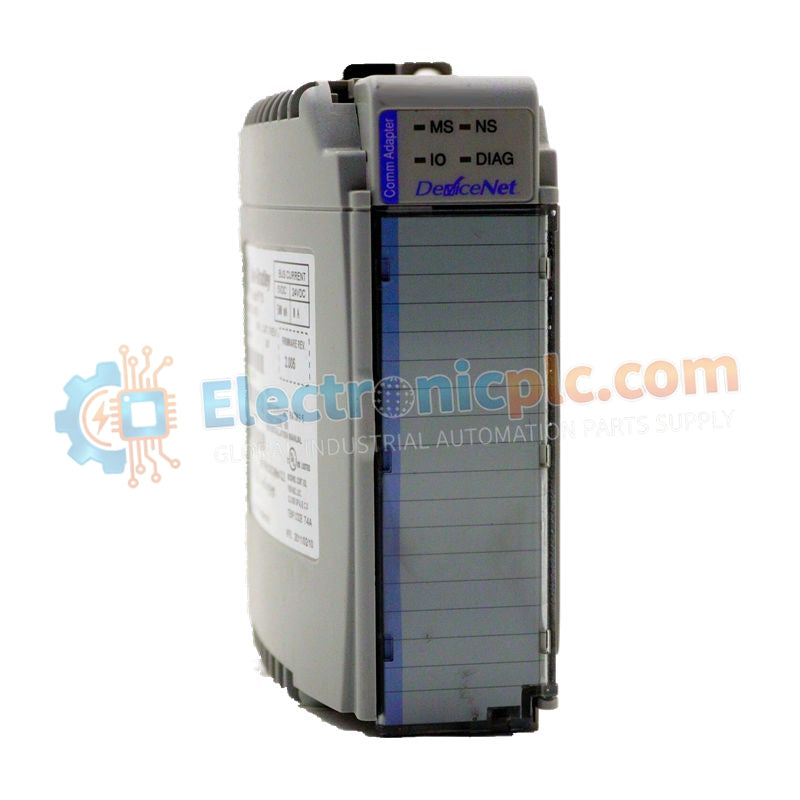
The 1769-ADN (Part Number: 1769-ADN) functions as a high-performance communication interface that allows 1769 Compact I/O modules to operate as a distributed station on a DeviceNet network. This adapter effectively decouples the I/O from the main controller, enabling remote mounting and distributed control architectures. Capable of managing up to 30 I/O modules in a single station, the 1769-ADN provides a scalable and cost-effective solution for expanding system reach without additional CPUs.
Engineered for industrial resilience, the 1769-ADN features robust ESD immunity and high shock/vibration resistance, ensuring stable performance in heavy-machinery environments. It acts as a gateway, translating the DeviceNet protocol into backplane communication for the attached 1769 modules. Placement of this adapter relative to the power supply is critical, with a specific distance rating that must be observed during hardware configuration to ensure signal integrity.
| Specification | Details |
|---|---|
| Network Protocol | DeviceNet |
| I/O Module Capacity | Supports up to 30 expansion modules |
| Power Supply Distance Rating | 4 modules (Series A); 5 modules (Series B) |
| Heat Dissipation | 4.7 Watts maximum |
| Isolation Voltage | Tested at 710V DC for 60 seconds |
| ESD Immunity | 6kV contact / 8kV air discharges (IEC 61000-4-2) |
| Emissions Standard | CISPR 11, Group 1, Class A |
| Dimensions (Standard) | 11.8 cm H x 5.0 cm W x 8.7 cm D |
The 1769-ADN is ideally suited for decentralized manufacturing cells, conveyor systems, and large-scale assembly lines where I/O points are physically distant from the main CompactLogix or PLC-5 controller. It is frequently used to integrate legacy DeviceNet infrastructure with modern 1769 I/O hardware.
Does the 1769-ADN require its own power supply?
Yes, the 1769-ADN must be used in conjunction with a 1769 power supply (such as the 1769-PA2 or 1769-PB2) to provide power to the backplane for the attached I/O modules.
How is the node address set on this adapter?
The DeviceNet node address (MAC ID) is typically configured using the hardware switches located on the front of the module or through software such as RSNetWorx for DeviceNet.


