
My Cart
0 items
Genuine Automation Parts | Worldwide Express Delivery | 12-Month Warranty — [GET A QUOTE]

The 1769-L30ER is a high-performance L3 processor from the Allen-Bradley CompactLogix 5370 family, designed for small to medium-sized applications. It provides seamless integration of control software, hardware, and I/O modules, offering a scalable and...
Availability: Low stock: 99 left
Reliable Worldwide Delivery
30-Day Money-Back Guarantee
Need more details? Read our fullShipping PolicyandRefund Policy.


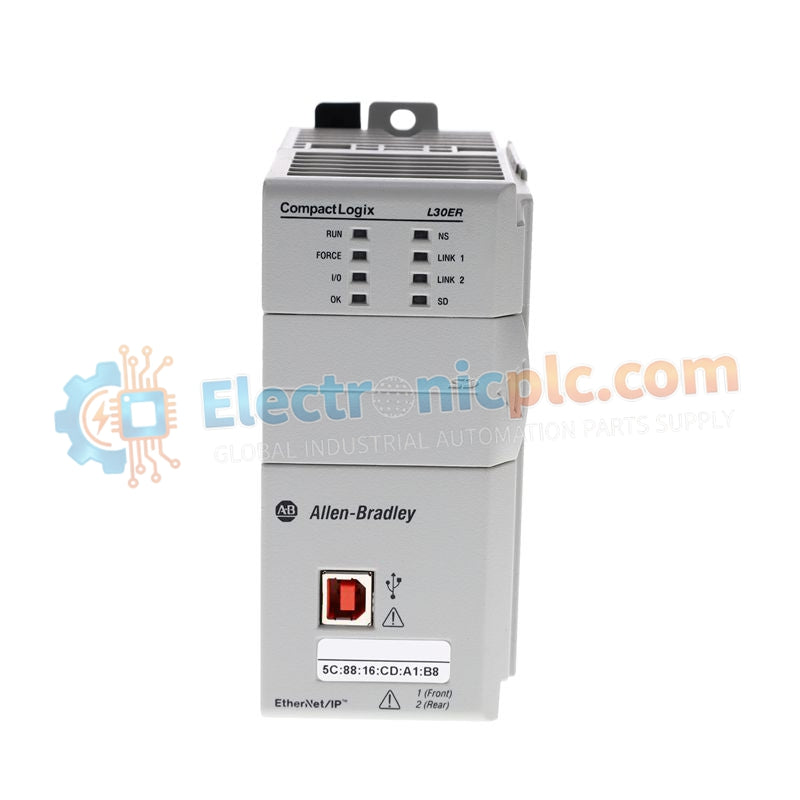
The 1769-L30ER is a high-performance L3 processor from the Allen-Bradley CompactLogix 5370 family, designed for small to medium-sized applications. It provides seamless integration of control software, hardware, and I/O modules, offering a scalable and efficient motion solution. The controller features dual Ethernet ports that support Device Level Ring (DLR) topology for enhanced network resiliency. The processor can support up to 16 EtherNet/IP nodes and 8 local I/O modules, making it ideal for machine builders and users who need compact control with robust connectivity.
| Specification | Details |
|---|---|
| Model Number | 1769-L30ER |
| Controller Category | CompactLogix 5370 L3 Processor |
| User Memory | 1 MB Integrated volatile memory |
| Non-Volatile Storage | 1784-SD1 (1 GB) Secure Digital card |
| Communication Ports | Dual Ethernet/IP (Copper) ports; 1 x USB 2.0 (Programming only) |
| Network Topology Support | DLR, Linear, and Star |
| EtherNet/IP Node Capacity | Up to 16 nodes |
| I/O Expansion | 8 Local 1769 I/O modules maximum |
| Programming Languages | LD, ST, FBD, SFC |
| Operating Temperature | 0 °C to 60 °C (32 °F to 140 °F) |
| Module Weight | 0.31 kg |
The 1769-L30ER is commonly used in packaging machinery, assembly lines, and material handling systems. Its dual-port Ethernet capability makes it effective for decentralized control in applications where real-time synchronization and data monitoring are crucial for operational efficiency.
Does this processor require a separate battery?
No, the CompactLogix 5370 series uses an internal energy storage module to maintain the real-time clock and back up volatile memory during power loss.
Can I use the USB port for HMI communication?
The USB port is for local programming, configuration, and firmware updates only. EtherNet/IP ports should be used for permanent HMI or SCADA communication.
What is the maximum number of I/O banks supported?
The 1769-L30ER supports up to 8 local I/O modules. For further expansion, EtherNet/IP distributed I/O (e.g., Point I/O) should be used.


