
My Cart
0 items
Genuine Automation Parts | Worldwide Express Delivery | 12-Month Warranty — [GET A QUOTE]

The 9200-01-01-01-00 is a self-generating velocity sensor based on moving-coil (electrodynamic) technology, commonly known as a Seismoprobe. Manufactured by Bently Nevada, this sensor outputs a voltage signal directly proportional to...
Availability: Low stock: 10 left
Reliable Worldwide Delivery
30-Day Money-Back Guarantee
Need more details? Read our fullShipping PolicyandRefund Policy.


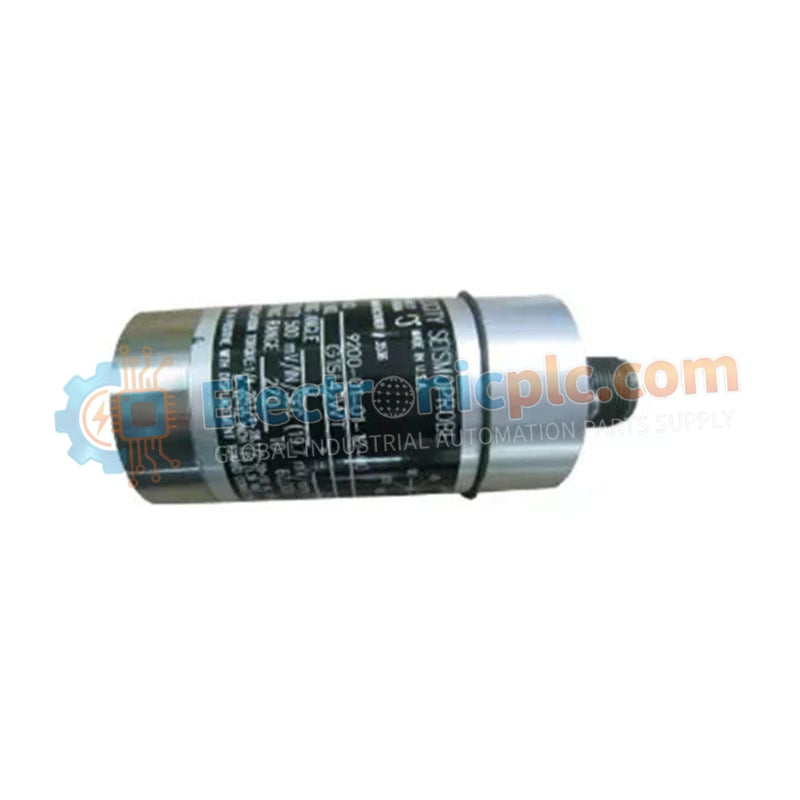
The 9200-01-01-01-00 is a self-generating velocity sensor based on moving-coil (electrodynamic) technology, commonly known as a Seismoprobe. Manufactured by Bently Nevada, this sensor outputs a voltage signal directly proportional to vibration velocity.
Unlike powered accelerometers, it requires no external power supply, making it highly reliable for both permanent installations and portable diagnostic measurements. It is widely used for monitoring bearing housings and machine casings in heavy industrial equipment.
| Parameter | Specification |
|---|---|
| Model | 9200-01-01-01-00 |
| Transduction Principle | Moving-coil (Electrodynamic) |
| Standard Sensitivity | 20 mV/mm/s (500 mV/in/s) ±5% |
| Mounting Orientation | 0° ±2.5° (Vertical configuration) |
| Minimum Frequency Response | 4.5 Hz (270 cpm) |
| Upper Frequency Limit | 1,000 Hz (60,000 cpm) |
| Transverse Sensitivity | <5% of sensitive axis |
| Shock Survivability | 50 g peak (Transverse axis) |
| Connector Type | Top-mounted integral connector |
| Mounting Thread | 1/4-20 UNC stud |
| Operating Temperature | –29°C to +121°C (–20°F to +250°F) |
| Hazardous Area Rating | 00 (Standard, non-hazardous area) |
The 9200-01-01-01-00 is optimized for mid- to high-speed rotating machinery where casing velocity is the preferred measurement parameter. Typical applications include:
Large industrial fans
Centrifugal pumps
Electric motor housings
Vertical shaft machines
General-purpose rotating equipment
Its 0° vertical mounting configuration makes it particularly suitable for machines with vertical shafts or vertically oriented casing surfaces.
Why choose this over a piezo-velocity sensor?
As a self-generating device, the 9200-01-01-01-00 is inherently immune to power-supply noise and electronic interference that can affect powered sensors. It also simplifies integration into legacy monitoring systems that accept direct velocity inputs.
Does this unit require a transmitter?
The sensor can output directly to a voltmeter or oscilloscope for spot checks. However, for continuous monitoring and integration into DCS platforms, it is typically connected to a Bently Nevada vibration monitor or a 4–20 mA transmitter module.


