
My Cart
0 items
Genuine Automation Parts | Worldwide Express Delivery | 12-Month Warranty — [GET A QUOTE]

The TK3-2E is a precision-engineered calibration tool manufactured by Bently Nevada (Baker Hughes / GE) for the verification and troubleshooting of proximity transducer systems. This portable instrument simulates shaft vibration and displacement, allowing...
Availability: Low stock: 10 left
Reliable Worldwide Delivery
30-Day Money-Back Guarantee
Need more details? Read our fullShipping PolicyandRefund Policy.


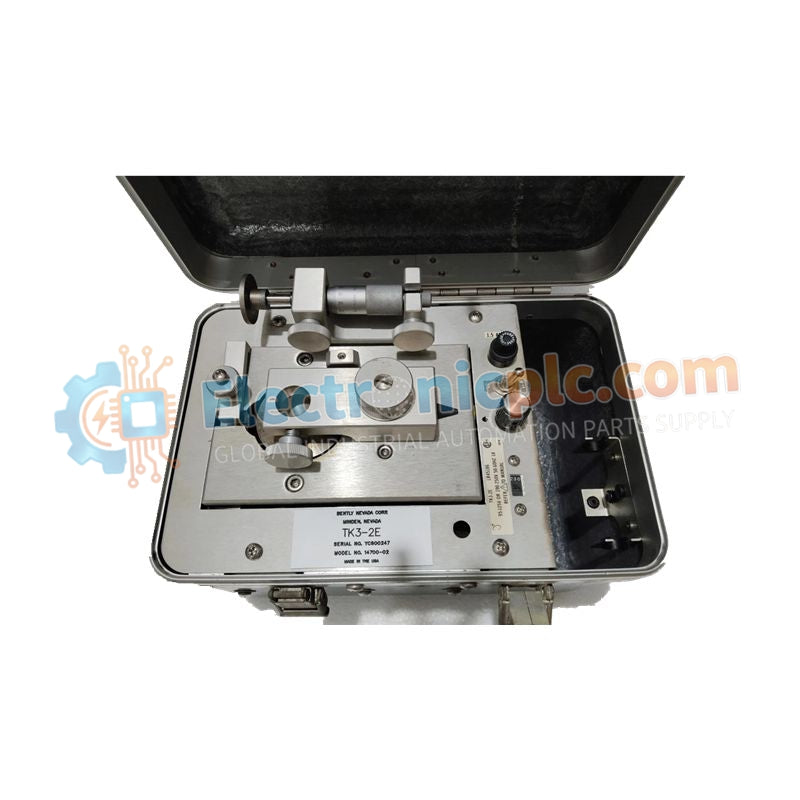
The TK3-2E is a precision-engineered calibration tool manufactured by Bently Nevada (Baker Hughes / GE) for the verification and troubleshooting of proximity transducer systems. This portable instrument simulates shaft vibration and displacement, allowing maintenance technicians to calibrate Proximitor sensors and monitoring systems in both field and laboratory environments. It is specifically designed to verify the linearity and frequency response of 3300 XL and other proximity probe series, ensuring the accuracy of machinery protection systems.
| Specification | Details |
|---|---|
| Model Designation | TK3-2E |
| Calibration Target | 4140 Steel (standard), others available |
| Power Source | Dual-powered (Electric motor driven) |
| Spindle Range | 0 to 25.4 mm (0 to 1 inch) |
| Micrometer Resolution | 0.01 mm / 0.001 inch |
| Vibration Simulation | Variable-speed motor for dynamic testing |
| Physical Footprint | 28.5 cm × 20.0 cm × 23.0 cm |
| Net Weight | 6.02 kg |
The TK3-2E is primarily used for Mechanical Runout and Electrical Runout simulations. By mounting a proximity probe into the device bracket, engineers can verify the voltage-to-gap ratio (typically 200 mV/mil or 7.87 V/mm) without rotating the actual machine shaft. This enables pre-installation testing of probes and extension cables, significantly reducing downtime.
The integrated electric-driven spindle allows for dynamic vibration simulation, enabling technicians to validate the response of vibration monitoring systems across a range of frequencies.
Q: What is the difference between the TK3-2E and the TK3-2G?
A: The TK3-2E features an electric motor for dynamic vibration simulation, while the TK3-2G is a manual (hand-cranked) unit primarily used for static displacement calibration.
Q: Does the TK3-2E include the wobble plate?
A: Yes, the unit incorporates a precision-machined wobble plate, which simulates a vibrating shaft surface and is essential for verifying the dynamic accuracy of vibration monitors and alarm setpoints.


