
My Cart
0 items
Genuine Automation Parts | Worldwide Express Delivery | 12-Month Warranty — [GET A QUOTE]

The Yokogawa MX3*D, also cataloged as the MX3*D Existing I/O Card, operates as a critical interface module within Yokogawa’s legacy and transition-phase control architectures. This card facilitates the acquisition and...
Availability: Low stock: 99 left
Reliable Worldwide Delivery
30-Day Money-Back Guarantee
Need more details? Read our fullShipping PolicyandRefund Policy.


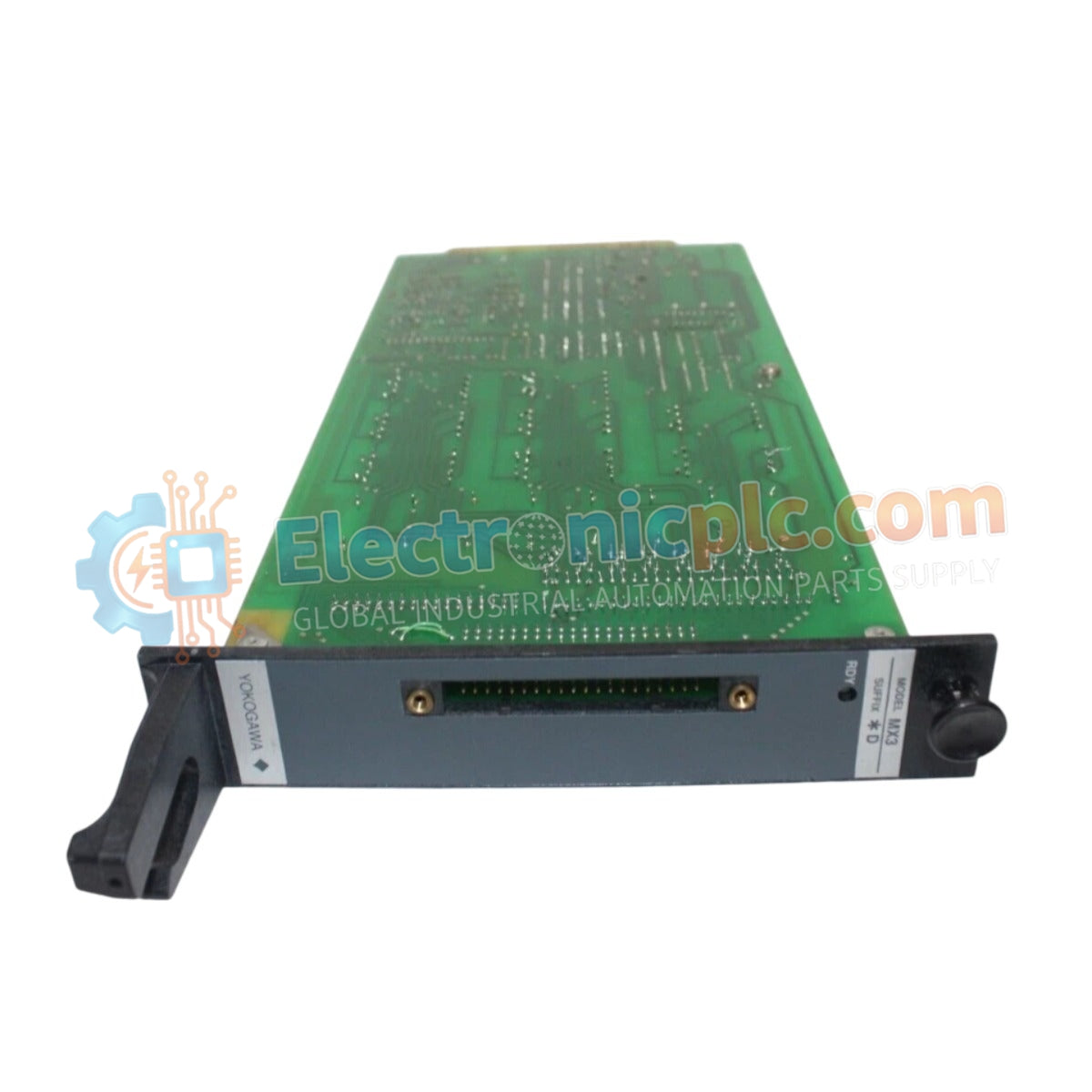
The Yokogawa MX3*D, also cataloged as the MX3*D Existing I/O Card, operates as a critical interface module within Yokogawa’s legacy and transition-phase control architectures. This card facilitates the acquisition and distribution of process signals, providing a robust hardware bridge between physical field instrumentation and the controller backplane.
| Parameter | Specification |
|---|---|
| Model | MX3*D |
| Brand | Yokogawa |
| Origin | Japan |
| Weight | 0.6 kg |
| Dimensions | 17.8 cm x 5.1 cm x 38.1 cm |
| Operating Temp | 0 to 50 deg C |
| Application | Field I/O Interface |
| Compatibility | Legacy Yokogawa Systems |
The MX3D module is engineered to provide reliable signal conditioning and transmission for distributed control applications. Its internal circuitry is designed for high-density I/O handling, allowing for efficient use of cabinet space while maintaining signal isolation to protect against cross-talk and transient noise. By converting varying field signals into standardized data streams recognized by the controller, the MX3D ensures that process variables are accurately reported for real-time monitoring and control loop execution.
Q: Does the MX3D support hot-swapping during active system operation? A: No, the MX3D is not designed for hot-swapping. The control station must be powered down or placed in a defined maintenance mode prior to module removal or installation to prevent backplane bus communication errors or electrical damage to the interface circuitry.
Q: How can I verify the integration status of the MX3*D in my control cabinet?
A: Status verification can be performed through the centralized engineering workstation by checking the I/O mapping configuration. Additionally, front-panel LED indicators provide real-time feedback regarding module health and communication activity.


