
My Cart
0 items
Genuine Automation Parts | Worldwide Express Delivery | 12-Month Warranty — [GET A QUOTE]

Configured for high-density analog signal acquisition within industrial automation platforms, the Yokogawa NFAI143-H50-S1 (NFAI143-H50-S1 Analog Input Module) provides direct physical/electrical execution.
Availability: Low stock: 50 left
Reliable Worldwide Delivery
30-Day Money-Back Guarantee
Need more details? Read our fullShipping PolicyandRefund Policy.


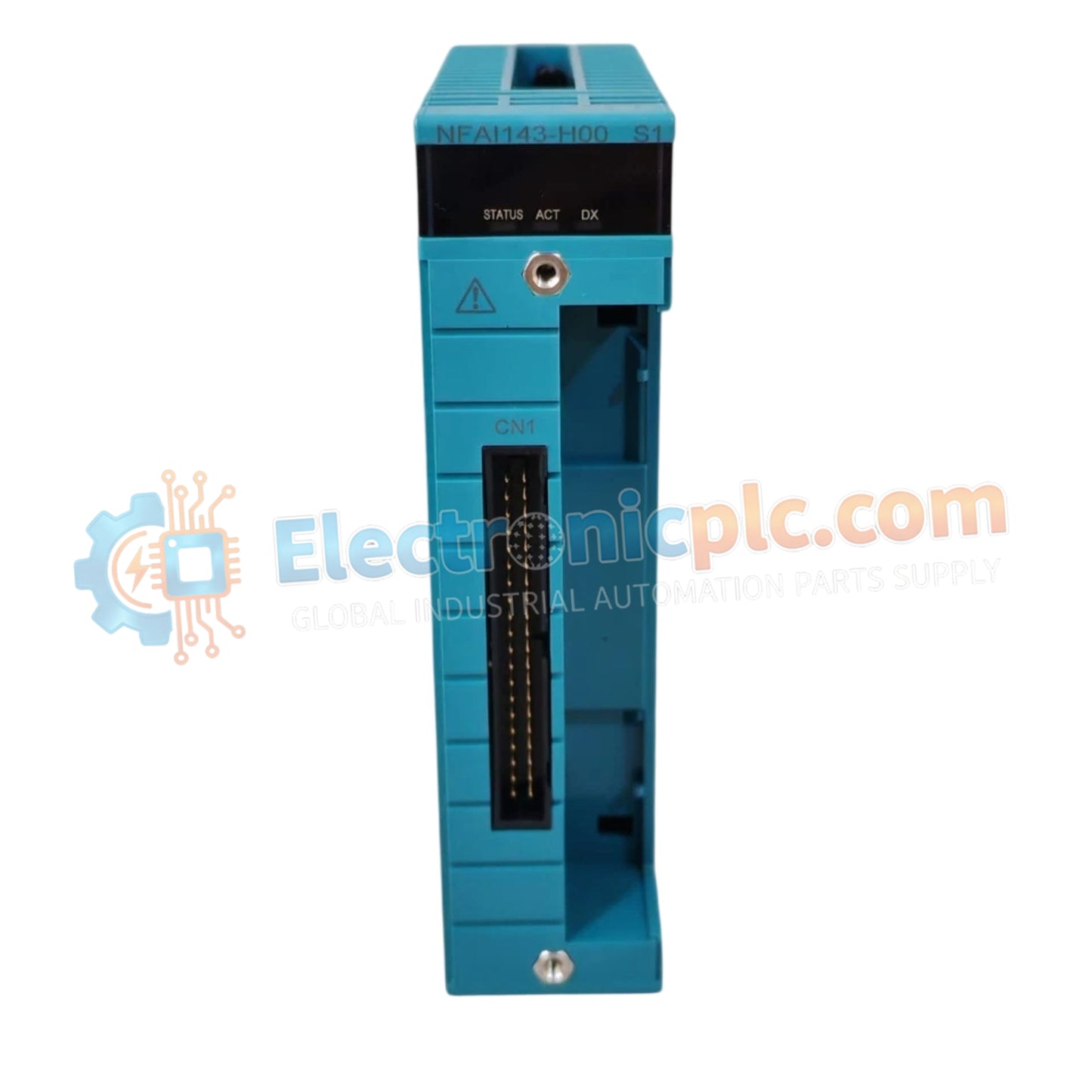
Configured for high-density analog signal acquisition within industrial automation platforms, the Yokogawa NFAI143-H50-S1 (NFAI143-H50-S1 Analog Input Module) provides direct physical/electrical execution.
| Parameter | Specification |
|---|---|
| Model | NFAI143-H50-S1 |
| Brand | Yokogawa |
| Origin | Japan |
| Weight | 0.3 kg |
| Dimensions | Standard Yokogawa I/O module form factor |
| Operating Temp | 0 to 60 deg C |
| Power Consumption | 230 mA at 5 V DC; 540 mA at 24 V DC |
| Input Channels | 16 isolated input channels |
| Input Signal | 4 to 20 mA DC current signals (max input current 24 mA) |
| Input Resistance | Approx. 250 ohm (Power ON); 500 kohm or more (Power OFF) |
| Accuracy & Timing | Accuracy plus-minus 0.1% of full scale; data update cycle 10 ms; step response time 100 ms |
The module executes precise analog-to-digital conversion across sixteen independent channels, supporting standard 4-20 mA HART loop protocol communications with transmitters. Electrical isolation between input channels and the system bus withstands 1500 V AC for 1 minute, preventing ground loop interference and voltage transients. Integrated transmitter power supply filtering, overcurrent protection, and configurable 2-wire or 4-wire jumper settings maintain signal stability under fluctuating field conditions.
Q: Does the NFAI143-H50-S1 module support online hot-swapping during active controller operation?
A: Yes, when installed within a baseplate architecture and node configuration supporting online maintenance, the module can be replaced without a system power shutdown.
Q: How is transmitter loop power supplied across the 16 input channels?
A: The module provides an internal transmitter power supply of 24.0 to 25.5 V DC with a 25 mA current limit per channel, configurable for 2-wire or 4-wire operation via setting pins.


