
My Cart
0 items
Genuine Automation Parts | Worldwide Express Delivery | 12-Month Warranty — [GET A QUOTE]

The YOKOGAWA ALR121-S51, often identified as an ALR121 Serial Communication Module, is a high-performance interface component designed for the CENTUM series distributed control systems. It facilitates seamless serial data integration...
Availability: In stock
Reliable Worldwide Delivery
30-Day Money-Back Guarantee
Need more details? Read our fullShipping PolicyandRefund Policy.


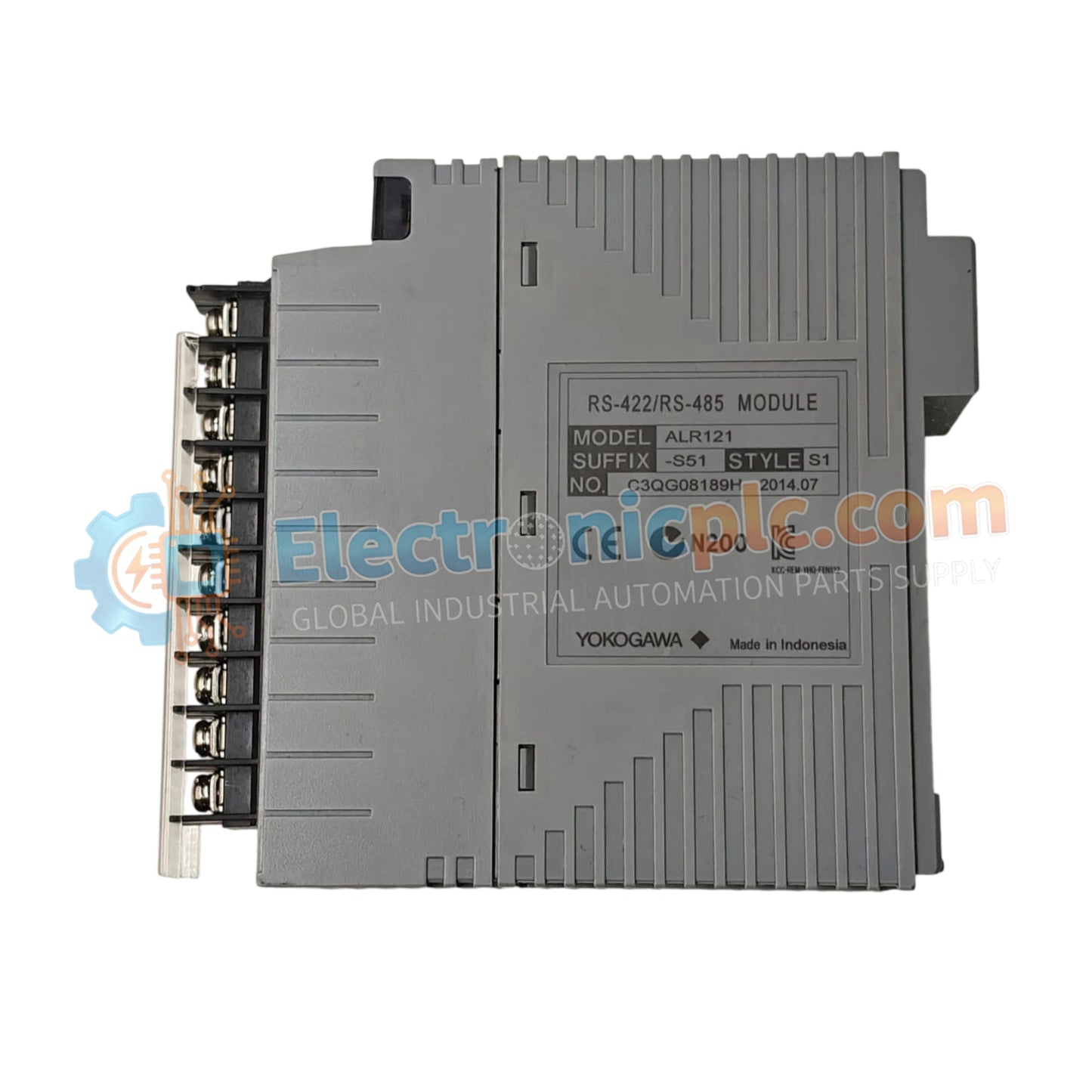
The YOKOGAWA ALR121-S51, often identified as an ALR121 Serial Communication Module, is a high-performance interface component designed for the CENTUM series distributed control systems. It facilitates seamless serial data integration between the control system and various field devices, such as analyzers, PLCs, and intelligent instrumentation.
| Parameter | Specification |
|---|---|
| Model | ALR121-S51 |
| Brand | YOKOGAWA |
| Origin | Japan |
| Weight | 0.2 kg |
| Dimensions | 7.7 cm x 4.2 cm x 10.6 cm |
| Operating Temp | 0 deg C to 50 deg C |
| Function | Serial Communication Interface |
| Compatibility | CENTUM VP / CS 3000 |
The ALR121-S51 is engineered to support standard serial protocols, including RS-232C and RS-422A/485, allowing it to adapt to diverse field communication requirements. By handling protocol conversion and data buffering at the module level, it reduces the computational load on the Field Control Unit (FCU) CPU. This architecture ensures high-speed, reliable data exchange, which is essential for maintaining real-time control loops and diagnostic monitoring in complex industrial environments.
Q: Does the ALR121-S51 support multi-drop serial communication?
A: Yes, when configured for RS-422A or RS-485 mode, the module supports multi-drop (daisy-chain) communication, allowing the controller to interface with multiple intelligent field devices on a single physical link.
Q: Is external hardware required for protocol conversion?
A: Generally, no. The ALR121-S51 is designed to handle common serial protocols natively. However, ensure that the physical wiring matches the port configuration (RS-232C vs. RS-422A/485) and that appropriate termination resistors are applied for long-distance RS-485 connections.


