
My Cart
0 items
Genuine Automation Parts | Worldwide Express Delivery | 12-Month Warranty — [GET A QUOTE]

Configured for high-density signal acquisition within STARDOM autonomous control architectures, the YOKOGAWA NFAT-141-S01 (NFAT141 Analog Input Module) provides direct physical execution of non-isolated analog current sensing.
Availability: In stock
Reliable Worldwide Delivery
30-Day Money-Back Guarantee
Need more details? Read our fullShipping PolicyandRefund Policy.


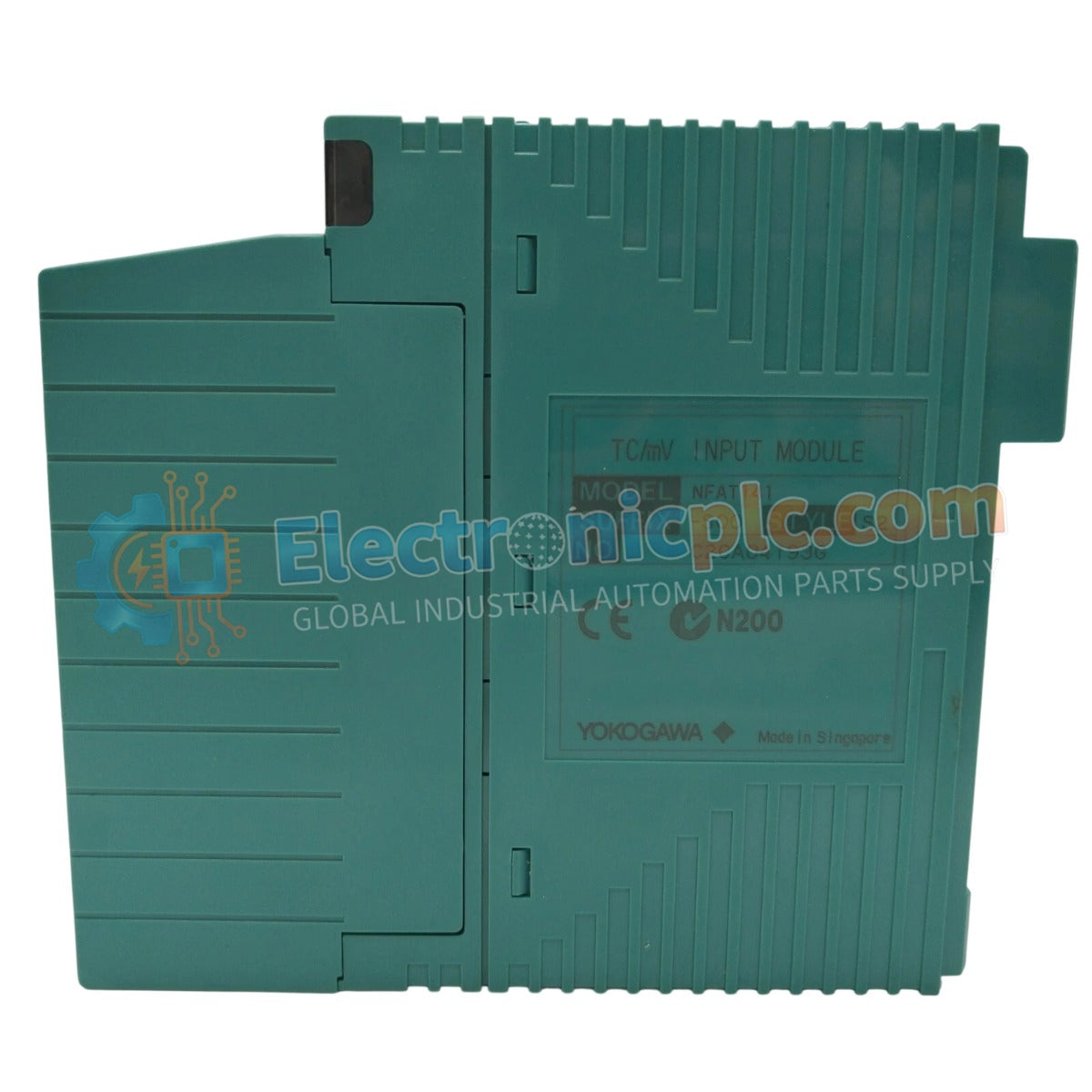
Configured for high-density signal acquisition within STARDOM autonomous control architectures, the YOKOGAWA NFAT-141-S01 (NFAT141 Analog Input Module) provides direct physical execution of non-isolated analog current sensing.
The NFAT-141-S01 follows a revision-controlled part numbering scheme. The -S01 designator signifies the Style S2 hardware iteration, which indicates specific mechanical form factor and internal circuit impedance matching optimized for STARDOM backplane communication.
| Parameter | Specification |
|---|---|
| Model | NFAT-141-S01 |
| Brand | YOKOGAWA |
| Origin | Japan |
| Weight | 0.2 kg (0.44 lbs) |
| Dimensions | Standard STARDOM module profile |
| Operating Temp | 0 deg C to 60 deg C |
| Power Consumption | 22.8-26.4 VDC |
| Channel Density | 16 channels |
| Input Type | Analog (Non-isolated) |
| Max Input Current | 27 mA |
| Connection Type | Pressure clamp terminal |
The NFAT-141-S01 module is designed for standard current loop monitoring. As a non-isolated analog input unit, it provides a common-ground reference for all 16 channels, which is required for applications where ground loops are managed at the cabinet or field distribution level. The hardware facilitates the acquisition of 4-20 mA signals, supporting integration with external HART loop protocol modems when deployed in loops requiring advanced field device diagnostics.
Q: Does the NFAT-141-S01 provide galvanic isolation between channels?
A: No. This specific model is a non-isolated input module. All 16 channels share a common ground reference, necessitating careful external signal conditioning if the field instruments are at different ground potentials.
Q: Can this module be used as a direct replacement for isolated modules?
A: Compatibility must be verified based on system grounding requirements. Replacing an isolated module with this non-isolated version may introduce ground loops if the field devices are not properly isolated from earth ground.


