
My Cart
0 items
Genuine Automation Parts | Worldwide Express Delivery | 12-Month Warranty — [GET A QUOTE]

Configured for high-density process data acquisition in distributed control system platforms, the Yokogawa SAI143-H53 S3 (SAI143-H53 Analog Input Module) provides direct physical and electrical execution...
Availability: In stock
Reliable Worldwide Delivery
30-Day Money-Back Guarantee
Need more details? Read our fullShipping PolicyandRefund Policy.


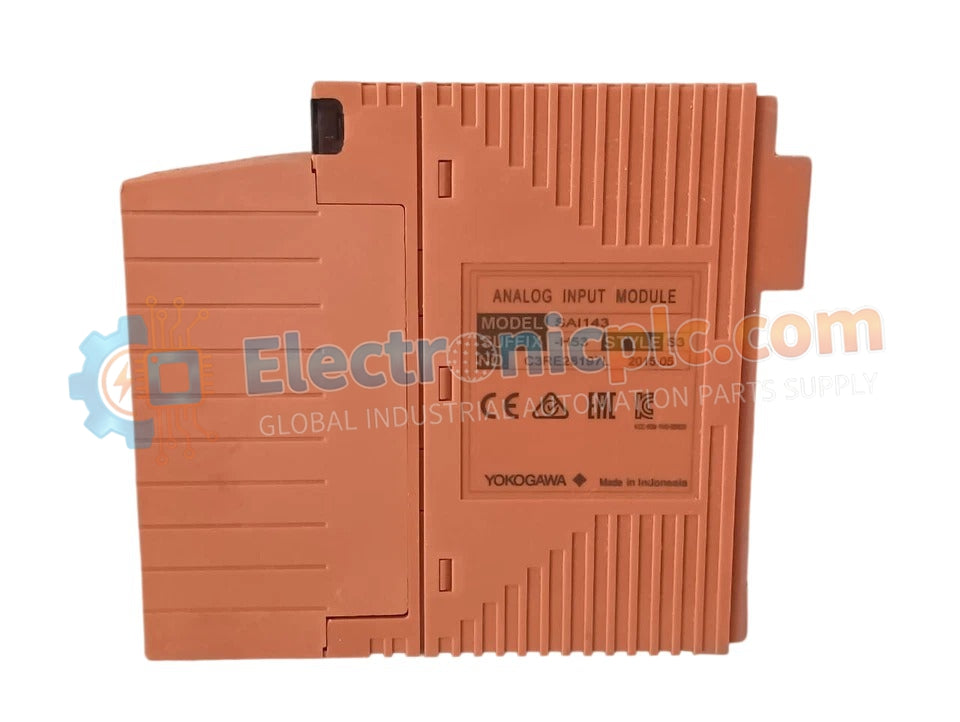
Configured for high-density process data acquisition in distributed control system platforms, the Yokogawa SAI143-H53 S3 (SAI143-H53 Analog Input Module) provides direct physical and electrical execution of multi-channel sensor signal processing.
| Parameter | Specification |
| Model | SAI143-H53 S3 |
| Brand | Yokogawa |
| Origin | Japan |
| Weight | 0.22 kg |
| Dimensions | 3.2 x 10.6 x 13 cm |
| Operating Temp | Standard industrial ambient |
| Power Consumption | System-bus dependent |
The SAI143-H53 module supports the 4-20 mA HART loop protocol, enabling bidirectional data exchange between field-mounted transmitters and the control network. To ensure signal fidelity within complex industrial environments, the module incorporates robust channel-to-channel isolation. This electrical segregation minimizes the risk of ground loops and signal interference across multi-channel inputs. Additionally, when interfacing with thermocouple or RTD sensors via external signal conditioning, the module supports cold junction compensation (CJC) to maintain precise temperature measurement accuracy across the connected loops.
Q: Does the SAI143-H53 support hot-swapping under normal load conditions?
A: Yes, the hardware architecture is designed to support modular insertion and removal; however, maintenance personnel must ensure that the corresponding software loop status is set to "Manual" or "Maintenance" mode prior to extraction to prevent system-wide process alarms.
Q: What are the electrical isolation limits for the input channels?
A: The module is engineered with galvanic isolation to protect against common-mode voltage spikes; refer to the specific system cabinet grounding documentation for the isolation voltage ratings relative to the system earth ground.
Verify that the I/O node power is disconnected before installing the module into the designated base plate slot to prevent electrical shorts on the backplane.
Ensure all field wiring is properly shielded and that the cable shield is terminated at the cabinet common ground bar; avoid running signal cables in parallel with high-voltage AC power lines to minimize induced noise.
Secure the front-panel locking mechanism after insertion to guarantee mechanical stability and proper electrical contact with the system bus.
After installation, perform a signal loop check using a calibrated current source to verify that the raw counts measured by the module correspond accurately to the 4-20 mA input range.


